
Back to all Articles
ChatGPT Ads: The Next Big Advertising Channel?
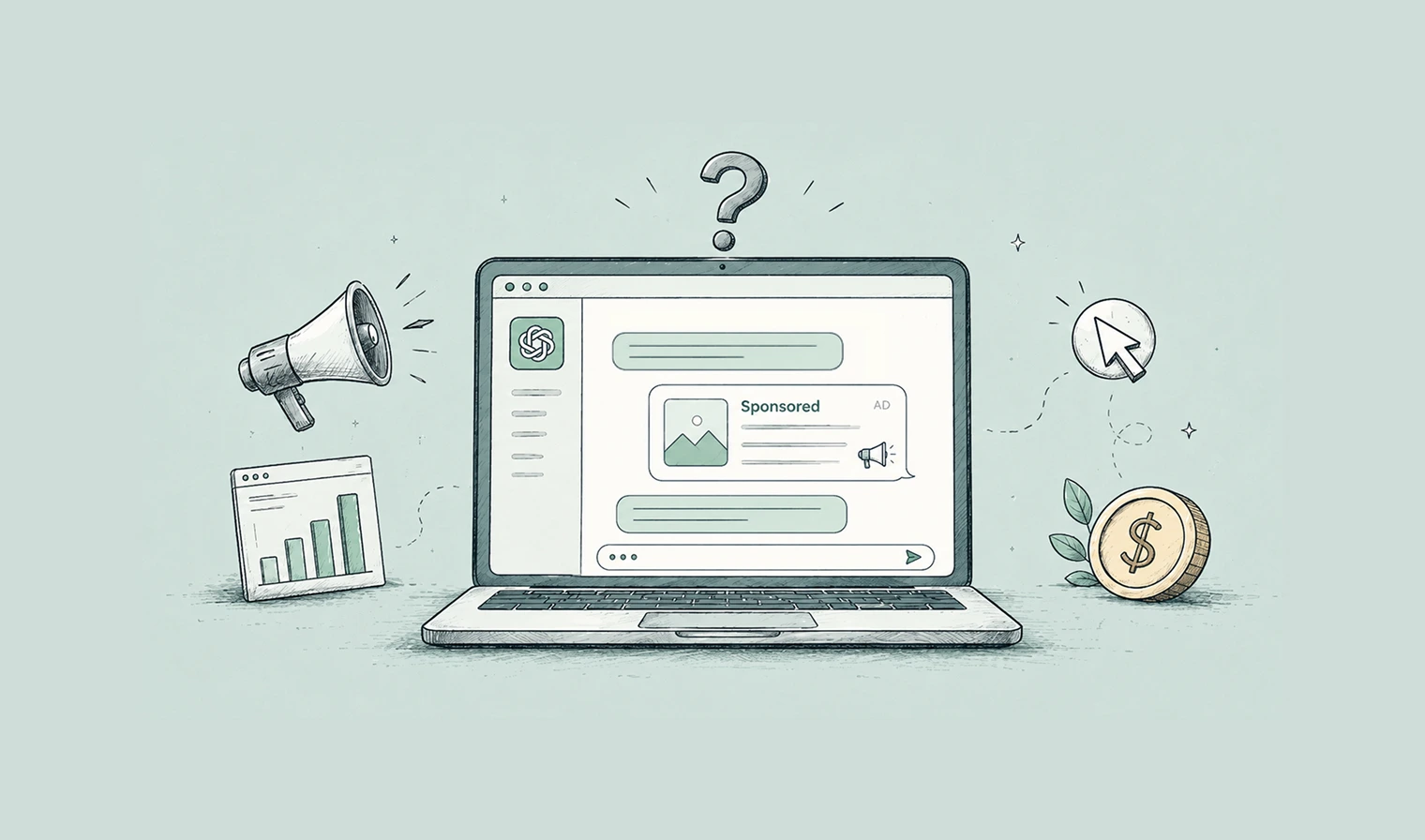
When people want to buy something, they do not always start with Google anymore.
That is exactly why ChatGPT Ads are becoming such an important topic.
They ask things like:
Because if people use AI to compare options, understand products, and make decisions, advertising will naturally follow that behavior.
OpenAI has started testing ads in ChatGPT and is building a real advertising ecosystem around it. The company already describes ChatGPT Ads as a way to reach people while they explore options, compare choices, and make decisions inside ChatGPT.
ChatGPT Ads may become a new layer in the buying journey – somewhere between search, recommendation, comparison, and decision-making.
In this guide, I’ll walk you through what ChatGPT Ads are, how ChatGPT Ads Manager works, what we know about ChatGPT Ads pricing, and how you can prepare before this channel becomes mainstream.
Check also: Google Ads vs Meta Ads · How to Rank on ChatGPT and LLMs · ChatGPT Statistics
That is exactly why ChatGPT Ads are becoming such an important topic.
They ask things like:
- “Which agency can help me generate B2B leads?”
- “What are the best running shoes for flat feet?”
- “Which accounting software is best for a small business?”
Because if people use AI to compare options, understand products, and make decisions, advertising will naturally follow that behavior.
OpenAI has started testing ads in ChatGPT and is building a real advertising ecosystem around it. The company already describes ChatGPT Ads as a way to reach people while they explore options, compare choices, and make decisions inside ChatGPT.
ChatGPT Ads may become a new layer in the buying journey – somewhere between search, recommendation, comparison, and decision-making.
In this guide, I’ll walk you through what ChatGPT Ads are, how ChatGPT Ads Manager works, what we know about ChatGPT Ads pricing, and how you can prepare before this channel becomes mainstream.
Check also: Google Ads vs Meta Ads · How to Rank on ChatGPT and LLMs · ChatGPT Statistics
⚡Quick Summary:
ChatGPT Ads are ads shown inside ChatGPT, designed to appear separately from ChatGPT’s organic answers. OpenAI says ads are clearly labeled, separate from responses, and built with user trust in mind.
OpenAI has started testing ads for users on Free and Go plans in selected markets. Paid plans like Plus, Pro, Business, Enterprise, and Edu are described by OpenAI as ad-free in its ads help documentation.
ChatGPT Ads Manager is becoming the platform where advertisers can create and manage campaigns, set budgets, add ad details, measure results, and optimize performance. OpenAI has also announced a beta self-serve Ads Manager for advertisers in the U.S. ChatGPT Ads pricing is no longer only theoretical. OpenAI has introduced cost-per-click bidding and expanded measurement tools, while industry reporting also mentions CPM and CPC buying models.
ChatGPT Ads can change how people discover brands.
ChatGPT Ads are ads shown inside ChatGPT, designed to appear separately from ChatGPT’s organic answers. OpenAI says ads are clearly labeled, separate from responses, and built with user trust in mind.
OpenAI has started testing ads for users on Free and Go plans in selected markets. Paid plans like Plus, Pro, Business, Enterprise, and Edu are described by OpenAI as ad-free in its ads help documentation.
ChatGPT Ads Manager is becoming the platform where advertisers can create and manage campaigns, set budgets, add ad details, measure results, and optimize performance. OpenAI has also announced a beta self-serve Ads Manager for advertisers in the U.S. ChatGPT Ads pricing is no longer only theoretical. OpenAI has introduced cost-per-click bidding and expanded measurement tools, while industry reporting also mentions CPM and CPC buying models.
ChatGPT Ads can change how people discover brands.
What are ChatGPT Ads?
ChatGPT Ads are paid placements that appear inside ChatGPT.
OpenAI describes them as relevant ads that fit naturally into the ChatGPT experience while people explore options, compare alternatives, weigh tradeoffs, and make decisions. They appear in an environment where users are often asking questions with real intent.
A normal Google search may look like this:
“best project management software”
A ChatGPT conversation may look like this:
“I run a small remote team and need a simple project management tool for client work, task tracking, deadlines, and file sharing. I do not want something too complex. What should I choose?”
That is a much richer signal.
The user is not just typing a keyword. They are explaining the problem, the context, the constraints, and the decision criteria. That is why ChatGPT Ads could become valuable. They may help brands show up when people are not just browsing, but actively thinking through a choice.
OpenAI describes them as relevant ads that fit naturally into the ChatGPT experience while people explore options, compare alternatives, weigh tradeoffs, and make decisions. They appear in an environment where users are often asking questions with real intent.
A normal Google search may look like this:
“best project management software”
A ChatGPT conversation may look like this:
“I run a small remote team and need a simple project management tool for client work, task tracking, deadlines, and file sharing. I do not want something too complex. What should I choose?”
That is a much richer signal.
The user is not just typing a keyword. They are explaining the problem, the context, the constraints, and the decision criteria. That is why ChatGPT Ads could become valuable. They may help brands show up when people are not just browsing, but actively thinking through a choice.
How do ChatGPT Ads work?
ChatGPT Ads are designed to appear in relevant moments during a conversation, not as random interruptions. OpenAI says ads may be selected based on the topic of the conversation, past chats, and past interactions with ads.
So, in simple terms, ChatGPT Ads work like this:
That is why ChatGPT Ads may be especially interesting for high-information buying journeys.
When someone needs a simple impulse purchase, a normal social ad may be enough. But when someone is comparing software, choosing an agency, evaluating financial tools, or trying to understand a complex service, a conversational ad can fit much more naturally.
So, in simple terms, ChatGPT Ads work like this:
- A user has a conversation in ChatGPT.
- ChatGPT identifies the topic and context of that conversation.
- The system checks whether a relevant sponsored placement is available.
- If an ad is shown, it appears clearly labeled and separated from the organic answer.
- The advertiser can measure aggregate performance, such as views and clicks.
- The user can dismiss the ad or manage personalization.
That is why ChatGPT Ads may be especially interesting for high-information buying journeys.
When someone needs a simple impulse purchase, a normal social ad may be enough. But when someone is comparing software, choosing an agency, evaluating financial tools, or trying to understand a complex service, a conversational ad can fit much more naturally.
Why you should pay attention to ChatGPT Ads
For years, most companies and marketers thought about online visibility in a familiar way:
Now there is another layer:
People use ChatGPT to research products, compare companies, summarize options, and understand what they should do next. OpenAI itself positions ChatGPT Ads around moments where people explore choices and make decisions. That changes the customer journey.
In the old journey, someone might:
In the AI journey, someone might:
That is the part people should pay attention to.
AI tools can reduce the number of clicks, but increase the importance of being included in the answer, recommendation, or sponsored placement.
- Google for search demand.
- Meta for audience targeting.
- LinkedIn for B2B visibility.
- TikTok for attention.
- SEO for organic traffic.
Now there is another layer:
- AI-assisted discovery.
People use ChatGPT to research products, compare companies, summarize options, and understand what they should do next. OpenAI itself positions ChatGPT Ads around moments where people explore choices and make decisions. That changes the customer journey.
In the old journey, someone might:
- Search on Google.
- Click a few links.
- Compare websites.
- Read reviews.
- Contact a company.
In the AI journey, someone might:
- Ask ChatGPT for recommendations.
- Get a short list of options.
- Ask follow-up questions.
- Compare pros and cons.
- Click only one or two sources.
- Make a decision faster.
That is the part people should pay attention to.
AI tools can reduce the number of clicks, but increase the importance of being included in the answer, recommendation, or sponsored placement.
How OpenAI is building its advertising ecosystem
OpenAI is not just placing random ads into ChatGPT. It is building an advertising ecosystem.
The official OpenAI Ads page already talks about campaign creation, ad details, launching campaigns, measuring results, editing campaigns, and optimizing performance. It also shows Ads Manager as the place where advertisers can create accounts, campaigns, and access help resources. That is important because it means ChatGPT Ads are moving toward a proper paid media platform.
OpenAI has also announced new ways to buy ChatGPT ads, including CPC bidding, expanded measurement tools, and a beta self-serve Ads Manager for advertisers in the U.S.
We have seen similar patterns before with Google, Meta, TikTok, and Amazon.
The difference is that OpenAI has a harder trust problem. People don’t use ChatGPT like they use a social feed. They ask it for help, advice, explanations, and recommendations. So OpenAI has to make ads useful without making the product feel corrupted. If ChatGPT starts feeling like a paid recommendation machine, users will lose trust fast.
The official OpenAI Ads page already talks about campaign creation, ad details, launching campaigns, measuring results, editing campaigns, and optimizing performance. It also shows Ads Manager as the place where advertisers can create accounts, campaigns, and access help resources. That is important because it means ChatGPT Ads are moving toward a proper paid media platform.
OpenAI has also announced new ways to buy ChatGPT ads, including CPC bidding, expanded measurement tools, and a beta self-serve Ads Manager for advertisers in the U.S.
- That is how most ad platforms grow:
- The first tests are limited and controlled.
- Selected advertisers get early access.
- Buying tools become easier to use.
- Reporting and bidding options get better.
- The platform gradually opens to more businesses.
We have seen similar patterns before with Google, Meta, TikTok, and Amazon.
The difference is that OpenAI has a harder trust problem. People don’t use ChatGPT like they use a social feed. They ask it for help, advice, explanations, and recommendations. So OpenAI has to make ads useful without making the product feel corrupted. If ChatGPT starts feeling like a paid recommendation machine, users will lose trust fast.
What is ChatGPT Ads Manager?
ChatGPT Ads Manager is the platform advertisers can use to create and manage advertising campaigns inside ChatGPT.
OpenAI’s ads page says that after signing up, advertisers are taken into Ads Manager, where they can create an account, create campaigns, and access step-by-step Help Center resources. It also describes the campaign process as creating a campaign, adding ad details, launching, measuring results, editing campaigns, and optimizing performance.
OpenAI has also announced a beta self-serve Ads Manager that lets advertisers in the U.S. sign up and buy ads directly to appear in ChatGPT.
So yes, ChatGPT Ads Manager is not just a rumor anymore. It is becoming the control center for ChatGPT advertising.
OpenAI’s ads page says that after signing up, advertisers are taken into Ads Manager, where they can create an account, create campaigns, and access step-by-step Help Center resources. It also describes the campaign process as creating a campaign, adding ad details, launching, measuring results, editing campaigns, and optimizing performance.
OpenAI has also announced a beta self-serve Ads Manager that lets advertisers in the U.S. sign up and buy ads directly to appear in ChatGPT.
So yes, ChatGPT Ads Manager is not just a rumor anymore. It is becoming the control center for ChatGPT advertising.
How ChatGPT Ads Manager could work
Based on OpenAI’s current description, the workflow is likely to feel familiar to anyone who has used Google Ads or Meta Ads.
A business may need to:
In Google Ads, you often target keywords.
In Meta Ads, you often target audiences, behaviors, placements, and creative signals.
In ChatGPT Ads, the platform is built around conversations, context, and real-time decisions. OpenAI says ChatGPT gives advertisers richer context signals because people share more context inside conversations. That could make targeting very different.
Instead of only asking:
The system may understand:
That is a major shift.
A business may need to:
- Create an advertiser account.
- Create a campaign.
- Set a campaign goal.
- Set a budget.
- Add ad details.
- Launch the campaign.
- Measure results.
- Edit and optimize performance.
In Google Ads, you often target keywords.
In Meta Ads, you often target audiences, behaviors, placements, and creative signals.
In ChatGPT Ads, the platform is built around conversations, context, and real-time decisions. OpenAI says ChatGPT gives advertisers richer context signals because people share more context inside conversations. That could make targeting very different.
Instead of only asking:
- “What keyword did the person type?”
The system may understand:
- “What problem is this person trying to solve?”
That is a major shift.
ChatGPT Ads pricing: What do you need to know?
At first, ChatGPT Ads were mainly discussed around CPM pricing, meaning advertisers paid for every 1,000 impressions. Early reports mentioned CPMs around $60, but more recent reporting suggests that prices have already dropped, with CPMs now landing somewhere around $25–$45 in some cases. That tells one thing clearly: the platform is still in a testing phase, and OpenAI is trying to find the right pricing model for advertisers.
The more important shift is CPC pricing.
OpenAI has started introducing cost-per-click ads inside ChatGPT, which means advertisers can pay when someone actually clicks, not just when an ad is shown. Right now some CPC bids are between $3 and $5 per click.
So CPC makes ChatGPT Ads easier to test and compare with channels like Google Ads or Meta Ads. But there is one complication. ChatGPT may influence decisions even when users do not click immediately.
For example, someone might see a sponsored recommendation, remember the brand, ask ChatGPT more follow-up questions, and later search for the company directly. That means attribution may be harder than in a simple search campaign.
So, in practice, ChatGPT Ads pricing may include:
The more important shift is CPC pricing.
OpenAI has started introducing cost-per-click ads inside ChatGPT, which means advertisers can pay when someone actually clicks, not just when an ad is shown. Right now some CPC bids are between $3 and $5 per click.
So CPC makes ChatGPT Ads easier to test and compare with channels like Google Ads or Meta Ads. But there is one complication. ChatGPT may influence decisions even when users do not click immediately.
For example, someone might see a sponsored recommendation, remember the brand, ask ChatGPT more follow-up questions, and later search for the company directly. That means attribution may be harder than in a simple search campaign.
So, in practice, ChatGPT Ads pricing may include:
- CPM — cost per thousand impressions,
- CPC — cost per click,
- CPA or conversion-based bidding in the future,
- campaign budgets,
- bidding controls,
- and performance-based optimization.
Can you sign up for ChatGPT Ads?
Yes, OpenAI is moving toward advertiser access, but availability still depends on rollout. OpenAI’s ads page says advertisers can start by signing up and entering Ads Manager, where they can create campaigns and manage advertising.
However, access may still vary by:
This is normal for a new ad platform.Google, Meta, TikTok, and Amazon all expanded their ad products in phases. The same thing is likely happening here.
However, access may still vary by:
- country,
- advertiser eligibility,
- testing phase,
- business type,
- campaign category,
- and OpenAI’s rollout schedule.
This is normal for a new ad platform.Google, Meta, TikTok, and Amazon all expanded their ad products in phases. The same thing is likely happening here.
ChatGPT Ads vs Google Ads vs Meta Ads
Here is the simplest comparison:
Platform
Main Role
Typical User Mindset
Google Ads
Capture existing demand
“I’m searching for this now.”
Meta Ads
Create and shape demand
“This looks relevant to me.”
ChatGPT Ads
Influence AI-assisted decisions
“Help me choose the right solution.”
That is the key difference.
- Google Ads is strongest when people already know what they want.
- Meta Ads is strongest when people need to discover, notice, or warm up to an offer.
- ChatGPT Ads may be strongest when people are actively thinking through a decision and want help choosing.
How ChatGPT Ads could change performance marketing
ChatGPT Ads could change performance marketing in a few important ways. Not overnight. But gradually.
1. Intent may become more contextual
- Traditional search intent is based on keywords.
- Conversational intent is based on full problems.
That is a big difference. A keyword like “CRM software” is useful. But a prompt like:
- “I need a simple CRM for a small consulting business, mostly for follow-ups, email tracking, and sales pipeline management. I do not want something too expensive.”
is much more useful. It gives context. And in advertising, context is money.
2. Ads may need to become more helpful
A basic sales message may not work well inside AI conversations. Why?
Because the user is asking for help. So ads that interrupt the experience may feel annoying. But ads that match the user’s problem may feel useful. That means creative strategy may shift from:
Because the user is asking for help. So ads that interrupt the experience may feel annoying. But ads that match the user’s problem may feel useful. That means creative strategy may shift from:
- “Buy now.”
- “Here is why this solution fits your specific problem.”
3. Landing pages will matter even more
If someone comes from a ChatGPT conversation, they may arrive with a very specific question. Your landing page needs to continue that conversation. That means generic landing pages will struggle. Better landing pages will need:
This connects directly with AI SEO and answer-first content. If your page cannot explain the offer clearly to a human, it probably will not perform well after an AI-assisted click either.
- clear answers,
- comparison points,
- proof,
- FAQs,
- pricing logic,
- use cases,
- and strong next steps.
This connects directly with AI SEO and answer-first content. If your page cannot explain the offer clearly to a human, it probably will not perform well after an AI-assisted click either.
4. Attribution will get harder
ChatGPT Ads may influence people before they click. Or they may see an ad, ask more questions, return later through Google, and convert through a branded search. If your reporting is basic, you may miss part of that journey.
So businesses should prepare for:
This is where many companies will make bad decisions. They will judge ChatGPT Ads only by last-click conversions and miss the bigger influence.
So businesses should prepare for:
- assisted conversions,
- branded search lift,
- longer attribution paths,
- lower direct click volume in some cases,
- but potentially higher decision influence.
This is where many companies will make bad decisions. They will judge ChatGPT Ads only by last-click conversions and miss the bigger influence.
What are the risks of ChatGPT Ads?
ChatGPT Ads could change performance marketing in a few important ways. Not overnight. But gradually.
1. User trust is fragile
If people feel that ChatGPT recommendations are influenced by advertisers, trust can drop quickly. That would hurt users, OpenAI, and advertisers.
2. Costs are still hard to predict
ChatGPT Ads pricing is still difficult to predict.
Right now, early reports suggest that some costs are moving downward, especially around CPM pricing. That may make the platform more attractive for advertisers who want to test it before the market gets crowded.
But I would be careful with assuming that ChatGPT Ads will stay cheap.
OpenAI will naturally look for ways to increase ad revenue over time. As the platform opens to more markets, more businesses, and more self-serve advertisers, competition may also increase. And once more advertisers start bidding for the same high-intent conversations, prices can change quickly.
That is why I would not move an entire budget from Google Ads or Meta Ads into ChatGPT Ads just because the topic is trending. A smarter approach is to test carefully, compare results, and scale only when the numbers actually make sense.
Right now, early reports suggest that some costs are moving downward, especially around CPM pricing. That may make the platform more attractive for advertisers who want to test it before the market gets crowded.
But I would be careful with assuming that ChatGPT Ads will stay cheap.
OpenAI will naturally look for ways to increase ad revenue over time. As the platform opens to more markets, more businesses, and more self-serve advertisers, competition may also increase. And once more advertisers start bidding for the same high-intent conversations, prices can change quickly.
That is why I would not move an entire budget from Google Ads or Meta Ads into ChatGPT Ads just because the topic is trending. A smarter approach is to test carefully, compare results, and scale only when the numbers actually make sense.
3. Measurement may be limited or different
OpenAI is expanding measurement tools, but AI-native advertising is still new.
You may need time to understand:
You may need time to understand:
- what a good CTR looks like,
- what a good CPC looks like,
- how conversions behave,
- how ChatGPT Ads influence branded search,
- and how assisted conversions should be measured.
4. Not every business will be a fit immediately
Some businesses may benefit earlier than others. ChatGPT Ads may be especially interesting for products or services where people naturally ask for recommendations, comparisons, or explanations.
But if your offer is very local, very urgent, or very simple, Google Search may still be stronger at first.
But if your offer is very local, very urgent, or very simple, Google Search may still be stronger at first.
5. A new channel does not fix bad strategy
This is the most important risk.
Businesses often treat new ad platforms like escape routes from weak fundamentals. But if your offer is unclear, your landing page is weak, your tracking is broken, and your sales process is slow, ChatGPT Ads will not save you.
Businesses often treat new ad platforms like escape routes from weak fundamentals. But if your offer is unclear, your landing page is weak, your tracking is broken, and your sales process is slow, ChatGPT Ads will not save you.
How to prepare your brand for ChatGPT Ads
Here is how I would approach it.
1. Check how your brand appears in AI tools
Start by asking ChatGPT, Perplexity, Gemini, and Google AI-style results questions related to your category.
For example:
Then check:
This gives you a baseline.
For example:
- “What are the best agencies for B2B lead generation?”
- “How do I choose a performance marketing agency?”
- “What should I look for before hiring a Google Ads agency?”
- “Which companies help with AI SEO?”
Then check:
- Is your brand mentioned?
- Are your competitors mentioned?
- Are your articles cited anywhere?
- Is your positioning clear?
- Are AI tools describing your category accurately?
This gives you a baseline.
2. Build answer-first content
Your content should answer real buying questions directly. For example: Instead of writing only:
write:
That is clearer for users. It is also clearer for AI systems.
Strong content should include:
- “Our services are innovative and tailored.”
write:
- “We help B2B companies generate qualified leads through paid campaigns, landing pages, tracking, and conversion optimization.”
That is clearer for users. It is also clearer for AI systems.
Strong content should include:
- direct answers,
- use cases,
- comparisons,
- FAQs,
- examples,
- pricing logic,
- limitations,
- and practical next steps.
3. Fix landing pages before buying new traffic
If you plan to test ChatGPT Ads later, your landing pages need to be ready.
A good landing page should answer:
Don’t send paid AI traffic to a vague homepage and hope for miracles.
A good landing page should answer:
- What do you offer?
- Who is it for?
- What problem do you solve?
- Why should someone trust you?
- What happens after they contact you?
- What should they do next?
Don’t send paid AI traffic to a vague homepage and hope for miracles.
4. Prepare tracking and measurement
Before testing any new paid channel, make sure tracking works.
You should know:
Without this, ChatGPT Ads pricing will not mean much. A $5 click can be expensive or cheap depending on what happens after the click.
You should know:
- which form submissions came from which campaign,
- which calls came from which landing page,
- which leads became customers,
- what your cost per lead is,
- what your cost per qualified lead is,
- and what your close rate looks like.
Without this, ChatGPT Ads pricing will not mean much. A $5 click can be expensive or cheap depending on what happens after the click.
5. Compare ChatGPT Ads with existing channels
Don’t judge ChatGPT Ads in isolation.
Compare them with:
The question is: “Do ChatGPT Ads help generate better business outcomes than other options?”
Compare them with:
- Google Ads,
- Meta Ads,
- organic search,
- AI SEO,
- direct traffic,
- email,
- referral traffic.
The question is: “Do ChatGPT Ads help generate better business outcomes than other options?”
How Concept21 can help you prepare for AI advertising
At Concept21 Agency, we help businesses build performance campaigns that are not based on guessing.
That includes:
ChatGPT Ads may become an important paid channel, but the fundamentals still matter.
You still need:
If you want to prepare your brand for ChatGPT Ads, AI search, and future advertising channels, book a consultation with Concept21 Agency.
That includes:
- choosing the right paid channel,
- planning lead generation campaigns,
- building landing page strategy,
- setting up tracking,
- improving campaign structure,
- analyzing funnel performance,
- preparing brands for AI-driven discovery.
ChatGPT Ads may become an important paid channel, but the fundamentals still matter.
You still need:
- a clear offer,
- strong positioning,
- clean tracking,
- a landing page that converts,
- a campaign strategy connected to real business goals.
If you want to prepare your brand for ChatGPT Ads, AI search, and future advertising channels, book a consultation with Concept21 Agency.
Should you care about ChatGPT Ads?
ChatGPT Ads may become one of the most important new advertising channels because they appear close to decision-making moments.
People use ChatGPT to compare, choose, learn, and plan. That is valuable.
But the winners will not be the businesses that simply use ChatGPT Ads. The winners will be the businesses that understand the full AI journey:
People use ChatGPT to compare, choose, learn, and plan. That is valuable.
But the winners will not be the businesses that simply use ChatGPT Ads. The winners will be the businesses that understand the full AI journey:
- how people ask questions,
- how they compare options,
- how they discover brands,
- how ads fit into that experience,
- how to convert that attention into real business results.
F.A.Q
Are ChatGPT Ads available now?

Yes, OpenAI has started testing ads in ChatGPT and has launched official resources for advertising in ChatGPT. Availability still depends on rollout, plan type, market, and advertiser access.
How much do ChatGPT Ads cost?
ChatGPT Ads pricing is still evolving. OpenAI has introduced cost-per-click bidding and expanded measurement tools, and industry reporting also mentions CPM-based buying. Final costs will likely depend on competition, campaign type, targeting, market, and bidding model.
What is ChatGPT Ads Manager?
ChatGPT Ads Manager is the platform advertisers use to create and manage ChatGPT Ads campaigns. OpenAI describes Ads Manager as the place where advertisers can create accounts, set up campaigns, add ad details, measure results, edit campaigns, and optimize performance.
How can I sign up for ChatGPT Ads?
Businesses can start from OpenAI’s official advertising page. OpenAI says advertisers can sign up and access Ads Manager, though access may still depend on country, rollout phase, and advertiser eligibility.
Are ChatGPT Ads better than Google Ads?
Not necessarily. Google Ads is still stronger when people are actively searching for something urgent or specific. ChatGPT Ads may be better for research, comparison, and recommendation moments. They are different channels with different roles.
