
Back to all Articles
Do You Need a Website for Your Business? Let’s Find Out
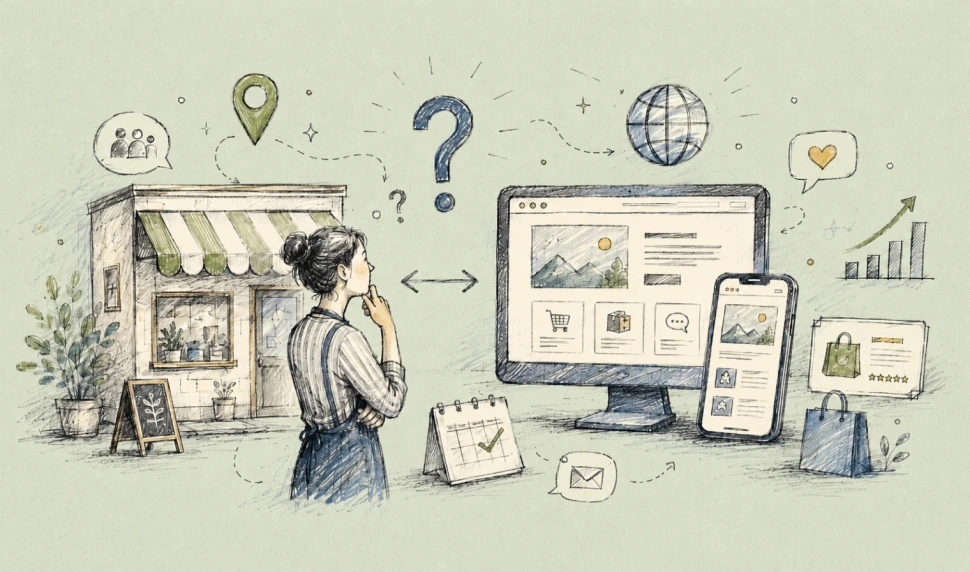
Many business owners ask the same question today:
Do I need a website for my business if I already have social media, Google Business Profile, referrals, booking platforms, or marketplace listings?
It is a fair question.
Years ago, the answer was obvious. If you had a business, you needed a website. Today, things feel more complicated. Customers can find you on Instagram. They can read your Google reviews. They can discover you through Booking, local directories, marketplaces, Facebook groups, TikTok, or even AI tools like ChatGPT.
So, is a website still worth it? In most cases, yes.
A website is not just an online brochure. It is your owned digital home base, where people verify your business, understand your offer, build trust, and take the next step.
Social media, referrals, listings, and AI can help people discover you. But your website helps them decide if they should trust you.
In this guide, I’ll walk you through why businesses still need websites, when social media is not enough, when a full website may not be necessary yet, and how to use a simple checklist to decide what your business really needs.
Check also: Small Business Website: The Do's and Don'ts · Benefits of a Multilingual Website · Multilingual Website Best Practices
Do I need a website for my business if I already have social media, Google Business Profile, referrals, booking platforms, or marketplace listings?
It is a fair question.
Years ago, the answer was obvious. If you had a business, you needed a website. Today, things feel more complicated. Customers can find you on Instagram. They can read your Google reviews. They can discover you through Booking, local directories, marketplaces, Facebook groups, TikTok, or even AI tools like ChatGPT.
So, is a website still worth it? In most cases, yes.
A website is not just an online brochure. It is your owned digital home base, where people verify your business, understand your offer, build trust, and take the next step.
Social media, referrals, listings, and AI can help people discover you. But your website helps them decide if they should trust you.
In this guide, I’ll walk you through why businesses still need websites, when social media is not enough, when a full website may not be necessary yet, and how to use a simple checklist to decide what your business really needs.
Check also: Small Business Website: The Do's and Don'ts · Benefits of a Multilingual Website · Multilingual Website Best Practices
⚡Quick Summary:
If you want the simple answer first, here it is: Yes, most businesses still need a website.
Here’s why:
If you want the simple answer first, here it is: Yes, most businesses still need a website.
Here’s why:
- A website gives your business credibility, control, and a clear place where people can understand what you offer.
- Social media is useful, but it is rented space.
- Google Business Profile can help people find you, but your website helps them understand and choose you.
- Referrals are powerful, but referred clients often check your website before they contact you.
- Booking platforms, marketplaces, and business directories can bring visibility, but they also control the rules, fees, ranking, and customer relationship.
- A website supports SEO, AI visibility, paid ads, lead generation, sales conversati
- ons, and customer trust.
- If you want to grow internationally, a multilingual website becomes even more important.
- You may not need a large custom website immediately, but most businesses need at least one clear, professional online home base.
Do I need a website for my business?
In most cases, yes, you need a website for your business.
A business website helps people verify that your company is real. It explains what you do better than a short social media bio, marketplace listing, or Google Business Profile description. It gives you a place you control.
That last part matters more than people think.
Your website supports:
For most businesses, it is basic infrastructure, like a phone number, email address, or sales presentation.
And here is another thing people often forget: your website can help you get found not only through Google, but also through emerging AI search experiences.
When someone asks an AI tool about companies, services, or solutions in your industry, where do you think that AI system gets information from?
It needs clear, trustworthy online sources. Your website is one of the most important sources you control.
A business website helps people verify that your company is real. It explains what you do better than a short social media bio, marketplace listing, or Google Business Profile description. It gives you a place you control.
That last part matters more than people think.
Your website supports:
- organic search,
- AI search visibility,
- paid campaigns,
- referrals,
- sales conversations,
- lead generation,
- customer education,
- and long-term brand value.
For most businesses, it is basic infrastructure, like a phone number, email address, or sales presentation.
And here is another thing people often forget: your website can help you get found not only through Google, but also through emerging AI search experiences.
When someone asks an AI tool about companies, services, or solutions in your industry, where do you think that AI system gets information from?
It needs clear, trustworthy online sources. Your website is one of the most important sources you control.
The real benefits of having a business website
A website should not exist just because “every business has one.” A good business website should have a job. It should help people understand your offer, trust your company, and contact you.
Here are the real benefits of having a business website.
Here are the real benefits of having a business website.
1. A website builds credibility and trust
People expect serious businesses to have a professional website.
That doesn’t mean every business needs a huge, expensive, custom platform from day one. But it does mean customers expect to find a clear, active, trustworthy online presence.
A website helps confirm that your business is real.
It gives visitors one central place to check:
You can also use your website to collect and display reviews, testimonials, case studies, project examples, before-and-after results, or portfolio work. That proof matters.
People don’t only want to know that you exist. They want to know if they can trust you.
That doesn’t mean every business needs a huge, expensive, custom platform from day one. But it does mean customers expect to find a clear, active, trustworthy online presence.
A website helps confirm that your business is real.
It gives visitors one central place to check:
- what you offer,
- who you help,
- how to contact you,
- what others say about you,
- what projects you have done,
- what results you can show,
- and whether your brand looks professional.
You can also use your website to collect and display reviews, testimonials, case studies, project examples, before-and-after results, or portfolio work. That proof matters.
People don’t only want to know that you exist. They want to know if they can trust you.
2. A website explains your offer clearly
Social media bios are short. Directory listings are limited. Google Business Profile descriptions are useful, but they don’t give you enough space to explain your full offer.
A website gives you room to explain:
This is especially important for service businesses, B2B companies, consultants, agencies, clinics, local services, and companies with more complex offers.
If your offer needs explanation, you need more than a social media profile. You need a place where people can understand the full picture.
A website gives you room to explain:
- your services,
- packages,
- process,
- pricing logic,
- FAQs,
- results,
- industries you work with,
- and what makes your business different.
This is especially important for service businesses, B2B companies, consultants, agencies, clinics, local services, and companies with more complex offers.
If your offer needs explanation, you need more than a social media profile. You need a place where people can understand the full picture.
3. A website helps generate customer inquiries
A website should not only “exist.” It should help people take the next step.
That next step may be:
This is one of the biggest reasons why businesses need a website. A good website turns interest into action.
And if your website has no clear call to action, no form, no booking path, and no contact option that is easy to find, then yes – your website may technically exist, but it is not doing its job.
That next step may be:
- filling out a contact form,
- booking a consultation,
- requesting a quote,
- calling your team,
- downloading a resource,
- joining a waitlist,
- subscribing to a newsletter,
- or buying a product.
This is one of the biggest reasons why businesses need a website. A good website turns interest into action.
And if your website has no clear call to action, no form, no booking path, and no contact option that is easy to find, then yes – your website may technically exist, but it is not doing its job.
4. A website supports SEO, AI SEO, and long-term organic traffic
A website can rank in Google. It can answer customer questions. It can bring traffic long after a social post disappears from the feed.
That is one of the biggest advantages of website content.
A social post may get attention for a day or a week. A helpful website page can bring visitors for months or years if it is well structured, useful, and optimized.
Your website can support:
This is where the importance of a good website for business becomes very clear.
A website is not only about how your brand looks today. It is also about how people find and understand your business over time.
That is one of the biggest advantages of website content.
A social post may get attention for a day or a week. A helpful website page can bring visitors for months or years if it is well structured, useful, and optimized.
Your website can support:
- local SEO,
- service pages,
- blog articles,
- FAQs,
- comparison pages,
- case studies,
- AI search visibility,
- and content that helps people make decisions.
This is where the importance of a good website for business becomes very clear.
A website is not only about how your brand looks today. It is also about how people find and understand your business over time.
5. A website improves paid campaign performance
If you run Google Ads, Meta Ads, LinkedIn Ads, or any other paid campaign, you need somewhere strong to send that traffic. Sending paid traffic to a weak, confusing, slow, or outdated page just wastes budget.
A good website or landing page helps paid campaigns perform better because it continues the promise from the ad.
If your ad says “Book a consultation,” but your website doesn’t explain the offer, show trust signals, or make booking easy, people will leave.
A website should support your advertising strategy, not quietly sabotage it in the background like a villain with bad UX.
A good website or landing page helps paid campaigns perform better because it continues the promise from the ad.
If your ad says “Book a consultation,” but your website doesn’t explain the offer, show trust signals, or make booking easy, people will leave.
A website should support your advertising strategy, not quietly sabotage it in the background like a villain with bad UX.
6. A website supports sales conversations
A website can also support your sales team. This is especially important for companies that sell services, custom solutions, or B2B offers.
Sales representatives can send prospects to one clear page that explains the offer, process, benefits, proof, and next steps.
A good website can answer repeated questions before a call, such as:
This makes sales conversations more productive. Instead of spending the first 20 minutes explaining basics, your sales team can focus on the real business problem.
Sales representatives can send prospects to one clear page that explains the offer, process, benefits, proof, and next steps.
A good website can answer repeated questions before a call, such as:
- What exactly do you do?
- Who do you work with?
- What does the process look like?
- What results can I expect?
- How do I contact you?
- Why should I trust you?
This makes sales conversations more productive. Instead of spending the first 20 minutes explaining basics, your sales team can focus on the real business problem.
7. A website gives your business independence
This may be the most underrated benefit. Your website gives you control.
You control:
You are not fully dependent on social media algorithms, marketplace rankings, directory rules, or third-party platforms. That doesn’t mean you should ignore those channels. Use them. But don’t let them own your entire digital presence.
If your whole business depends on one platform you don’t control, you are not building stability. You are renting visibility and hoping the landlord stays friendly.
Hope is not a growth strategy.
You control:
- the content,
- the message,
- the structure,
- the user journey,
- the tracking,
- the design,
- the conversion path,
- and the way your brand is presented.
You are not fully dependent on social media algorithms, marketplace rankings, directory rules, or third-party platforms. That doesn’t mean you should ignore those channels. Use them. But don’t let them own your entire digital presence.
If your whole business depends on one platform you don’t control, you are not building stability. You are renting visibility and hoping the landlord stays friendly.
Hope is not a growth strategy.
Growth Tip:
If your business needs a website that supports trust, SEO, and conversions, you can explore Concept21’s Website Development service.
If your business needs a website that supports trust, SEO, and conversions, you can explore Concept21’s Website Development service.
Why businesses still need websites in the age of social media?
Social media is useful. It helps your business get attention, publish updates, show personality, build community, and stay visible in front of potential customers. But social media doesn’t fully replace a website. The biggest problem is control.
On social media, you don’t control the platform. You don’t control the algorithm. You don’t control organic reach. You don’t control how your posts are distributed. You don’t even fully control whether your account will always be accessible.
That doesn't mean social media is bad. It means social media should support your website, not replace it.
Your website is still the place where your brand, offer, proof, content, and conversion path come together. It gives people a clear place to understand what you do, why they should trust you, and how they can contact you.
Social media can help people discover you. Your website helps them understand, verify, and choose you.
On social media, you don’t control the platform. You don’t control the algorithm. You don’t control organic reach. You don’t control how your posts are distributed. You don’t even fully control whether your account will always be accessible.
That doesn't mean social media is bad. It means social media should support your website, not replace it.
Your website is still the place where your brand, offer, proof, content, and conversion path come together. It gives people a clear place to understand what you do, why they should trust you, and how they can contact you.
Social media can help people discover you. Your website helps them understand, verify, and choose you.
What about AI search?
AI tools are changing how people search. Instead of typing short keywords, people now ask longer questions like:
AI tools can summarize information, compare options, and suggest next steps.
But here is the important part: AI still needs clear, trustworthy online information to understand businesses.
A structured website helps both humans and AI understand:
If your business has no clear website, AI tools may have less reliable information to work with.
So no, AI doesn’t remove the need for a website. It raises the standard for how clear, structured, and trustworthy your website needs to be.
- “What is the best accounting firm for a small business?”
- “Which agency can help me redesign my website?”
- “What should I look for before hiring a web development company?”
- “Which hotel in this city is best for families?”
- “What are the best options for a local dentist?”
AI tools can summarize information, compare options, and suggest next steps.
But here is the important part: AI still needs clear, trustworthy online information to understand businesses.
A structured website helps both humans and AI understand:
- what your business does,
- who you help,
- where you operate,
- what services you offer,
- what makes you credible,
- and how people can contact you.
If your business has no clear website, AI tools may have less reliable information to work with.
So no, AI doesn’t remove the need for a website. It raises the standard for how clear, structured, and trustworthy your website needs to be.
Do I need a website if I already have Facebook or Instagram?
In most cases, you still need a website if you already have Facebook or Instagram.
Yes, social media is still useful. Facebook, Instagram, TikTok, LinkedIn, and other platforms can help with:
But social media is not a full replacement for a professional website. Why?
Because social platforms control the environment.
They control:
Your account can lose reach. Your posts can stop performing. Your profile can be restricted. Your audience may not see your updates unless you pay.
That is the uncomfortable part of social media. It feels like your audience, but it is not fully yours. Social media is rented attention. Your website is an owned digital asset.
A Facebook or Instagram page also gives you limited space to explain your services, show proof, answer questions, structure your offer, and guide visitors toward a clear action. A website does that much better.
Also, many customers still Google your business before contacting you. If they find only a social profile and no website, some will not care. But others may wonder if your business is serious, established, or trustworthy.
That small doubt can cost you clients.
Yes, social media is still useful. Facebook, Instagram, TikTok, LinkedIn, and other platforms can help with:
- visibility,
- content,
- community,
- engagement,
- social proof,
- and advertising.
But social media is not a full replacement for a professional website. Why?
Because social platforms control the environment.
They control:
- reach,
- algorithms,
- rules,
- account access,
- ad costs,
- content formats,
- and how your business is displayed.
Your account can lose reach. Your posts can stop performing. Your profile can be restricted. Your audience may not see your updates unless you pay.
That is the uncomfortable part of social media. It feels like your audience, but it is not fully yours. Social media is rented attention. Your website is an owned digital asset.
A Facebook or Instagram page also gives you limited space to explain your services, show proof, answer questions, structure your offer, and guide visitors toward a clear action. A website does that much better.
Also, many customers still Google your business before contacting you. If they find only a social profile and no website, some will not care. But others may wonder if your business is serious, established, or trustworthy.
That small doubt can cost you clients.
Do I need a website if I have a Google Business Profile?
Yes, in most cases, you still need a website if you have a Google Business Profile.
Google Business Profile is great for local visibility. It can show:
For local businesses, it can be extremely valuable. But it is not enough to explain the full offer.
Google Business Profile works best when it is well maintained. That means you need good photos, accurate information, high-quality reviews, regular updates, and a strong position compared with competitors. In some cases, it may also be supported by ads.
But even then, it has limits. Your website can show much more:
Google Business Profile helps people find you. Your website helps them choose you. That is the difference.
Google Business Profile is great for local visibility. It can show:
- reviews,
- location,
- opening hours,
- phone number,
- photos,
- services,
- directions,
- and basic business information.
For local businesses, it can be extremely valuable. But it is not enough to explain the full offer.
Google Business Profile works best when it is well maintained. That means you need good photos, accurate information, high-quality reviews, regular updates, and a strong position compared with competitors. In some cases, it may also be supported by ads.
But even then, it has limits. Your website can show much more:
- detailed services,
- pricing logic,
- case studies,
- FAQs,
- portfolio,
- team,
- process,
- booking forms,
- quote forms,
- and content that answers customer questions.
Google Business Profile helps people find you. Your website helps them choose you. That is the difference.
Do I need a website if I get clients through referrals?
Yes, you probably still need a website if you get clients through referrals.
Referrals are valuable. In many businesses, they are one of the best lead sources. If someone recommends your company, that already gives you trust. But referrals don’t remove the need for a website. They make the website even more important.
Why?
Because referred clients often check your business online before contacting you.
They may ask:
A good website makes referrals warmer and easier to convert.
It helps people understand your offer before the first call. It reduces repetitive explanations. It gives your sales team a useful support asset. It makes the next step easier.
A referral gets someone interested. A good website helps them feel safe enough to contact you.
There is also another point people don’t like to hear, but it matters: Referrals are not always reliable. You may have a strong referral network today. Great. But can you be sure it will always bring a stable flow of clients?
Referrals are valuable. In many businesses, they are one of the best lead sources. If someone recommends your company, that already gives you trust. But referrals don’t remove the need for a website. They make the website even more important.
Why?
Because referred clients often check your business online before contacting you.
They may ask:
- Is this company real?
- What exactly do they do?
- Do they work with businesses like mine?
- Can I see examples?
- Do they look professional?
- How do I contact them?
A good website makes referrals warmer and easier to convert.
It helps people understand your offer before the first call. It reduces repetitive explanations. It gives your sales team a useful support asset. It makes the next step easier.
A referral gets someone interested. A good website helps them feel safe enough to contact you.
There is also another point people don’t like to hear, but it matters: Referrals are not always reliable. You may have a strong referral network today. Great. But can you be sure it will always bring a stable flow of clients?
Do I need a website if I’m on marketplaces, or business listings?
Yes, in most cases, you still need a website if you are on marketplaces, directories, or business listing platforms. These platforms can be useful. They can bring visibility, traffic, bookings, and inquiries. But they also control a lot.
They can control:
That last part is important. On many platforms, your business appears as just one option among many competitors. Customers can compare you with competitors in seconds. The platform may show similar providers, cheaper offers, promoted listings, or alternative options right next to you.
That is good for the customer. But it is not always good for your brand.
In most cases, you also pay to be there in some way – through commissions, ads, listing fees, or reduced margins.
A website gives your business more independence.
It helps customers:
Platforms can send you traffic. But they shouldn’t own your entire customer relationship.
They can control:
- your ranking,
- fees,
- commissions,
- visibility,
- rules,
- customer data,
- messaging,
- reviews,
- and how your business appears next to competitors.
That last part is important. On many platforms, your business appears as just one option among many competitors. Customers can compare you with competitors in seconds. The platform may show similar providers, cheaper offers, promoted listings, or alternative options right next to you.
That is good for the customer. But it is not always good for your brand.
In most cases, you also pay to be there in some way – through commissions, ads, listing fees, or reduced margins.
A website gives your business more independence.
It helps customers:
- book directly,
- contact directly,
- understand your brand,
- see your full offer,
- and build trust outside the platform.
Platforms can send you traffic. But they shouldn’t own your entire customer relationship.
“A website costs too much” — Is that really true?
Cost is a fair concern. I understand why business owners worry about website cost.
A website can feel expensive, especially if you are a small business, new company, or service provider trying to control expenses.
It’s true that a website can be too expensive… if it has no clear business goal.
If you spend money on a beautiful website that doesn’t explain your offer, doesn’t generate leads, doesn’t help people trust you, and doesn’t support your sales process, then yes – that website was expensive.
Website cost depends on many things, including:
Not every business needs a huge custom website immediately.
Some businesses can start with a simple business website, a template-based website, or a focused landing page. This can be a smart option for companies that do not have a large budget yet, but still want a professional, good-looking, and functional online presence.
That is also why Concept21 offers website development based on ready-made templates – for businesses that need a well-made website, but are not ready for a fully custom project yet.
The point is to build the right website for your current business stage, not the biggest or most expensive one.
A website can feel expensive, especially if you are a small business, new company, or service provider trying to control expenses.
It’s true that a website can be too expensive… if it has no clear business goal.
If you spend money on a beautiful website that doesn’t explain your offer, doesn’t generate leads, doesn’t help people trust you, and doesn’t support your sales process, then yes – that website was expensive.
Website cost depends on many things, including:
- size,
- design,
- content,
- functionality,
- integrations,
- SEO needs,
- booking systems,
- ecommerce features,
- language versions,
- and whether you need a custom build or a simpler setup.
Not every business needs a huge custom website immediately.
Some businesses can start with a simple business website, a template-based website, or a focused landing page. This can be a smart option for companies that do not have a large budget yet, but still want a professional, good-looking, and functional online presence.
That is also why Concept21 offers website development based on ready-made templates – for businesses that need a well-made website, but are not ready for a fully custom project yet.
The point is to build the right website for your current business stage, not the biggest or most expensive one.
“I’m not technical” or “I don’t have time” — What should you do?
You don’t need to be technical to have a good website.
You don’t need to know code or you don’t need to understand hosting, UX, SEO, performance optimization, CMS setup, or development frameworks.
That is not your job.
As a business owner, your job is to know:
A good agency should handle the structure, design, development, mobile optimization, SEO basics, performance, and launch process. The process should be structured and simple. You shouldn’t have to “figure everything out” alone.
Start with the essentials:
That is enough to start building a clear website direction. The same applies to time.
Many business owners say: “I don’t have time for a website.” I get it. But here is the funny part: if your website is done well, it can save time later.
If you keep answering the same questions on calls, messages, and emails, your website should probably answer them for you. A good website can explain your services, show proof, answer FAQs, collect inquiries, and guide people toward the right next step.
If your website is well managed from the start, it can work for you like your best salesperson — 24/7 — without needing constant input from your side!
You don’t need to know code or you don’t need to understand hosting, UX, SEO, performance optimization, CMS setup, or development frameworks.
That is not your job.
As a business owner, your job is to know:
- what you offer,
- who you help,
- why people should trust you,
- what action visitors should take,
- and what business goal the website should support.
A good agency should handle the structure, design, development, mobile optimization, SEO basics, performance, and launch process. The process should be structured and simple. You shouldn’t have to “figure everything out” alone.
Start with the essentials:
- What do you offer?
- Who is it for?
- Why should people trust you?
- How can they contact you?
- What should they do next?
That is enough to start building a clear website direction. The same applies to time.
Many business owners say: “I don’t have time for a website.” I get it. But here is the funny part: if your website is done well, it can save time later.
If you keep answering the same questions on calls, messages, and emails, your website should probably answer them for you. A good website can explain your services, show proof, answer FAQs, collect inquiries, and guide people toward the right next step.
If your website is well managed from the start, it can work for you like your best salesperson — 24/7 — without needing constant input from your side!
A website is a must-have if you have international aspirations
If you want to reach customers in different countries, languages, or regions, a website becomes even more important. Social media alone is rarely enough for international trust.
A multilingual website can help you:
This matters for many types of businesses:
If someone discovers your business from another country, they need to understand your offer clearly.
👉 How to Make a Website Multilingual
Language plays a huge role in trust.
If your website only speaks one language while your customers speak several, you may be creating friction without realizing it. If you want to sell internationally, your website shouldn’t speak only one language while your customers speak five.
A multilingual website is not just a translation project. It is a growth asset.
A multilingual website can help you:
- explain your offer in the customer’s language,
- build trust in different markets,
- support international SEO,
- improve paid campaigns in different countries,
- increase conversion rates,
- and make your brand look more professional and scalable.
This matters for many types of businesses:
- ecommerce brands,
- SaaS companies,
- agencies,
- consultants,
- hotels,
- service providers,
- manufacturers,
- education companies,
- and businesses already getting inquiries from abroad.
If someone discovers your business from another country, they need to understand your offer clearly.
👉 How to Make a Website Multilingual
Language plays a huge role in trust.
If your website only speaks one language while your customers speak several, you may be creating friction without realizing it. If you want to sell internationally, your website shouldn’t speak only one language while your customers speak five.
A multilingual website is not just a translation project. It is a growth asset.
When you may not need a full website yet
I’m not going to pretend every business needs a huge website on day one. That would be easy to say. It would also be lazy.
Some businesses may not need a large website immediately.
You may be able to start with a landing page or simple one-page website if:
In that case, building a full website too early may create unnecessary cost and complexity.
But even then, you still need a professional online destination.
The goal is not always to build the biggest website. The goal is to build the right online asset for the current business stage.
Some businesses may not need a large website immediately.
You may be able to start with a landing page or simple one-page website if:
- you are testing one offer,
- you are validating a new service,
- you are running one campaign,
- you only need one clear contact path,
- you are not ready for a full website yet,
- or your business model is still changing.
In that case, building a full website too early may create unnecessary cost and complexity.
But even then, you still need a professional online destination.
- Somewhere to send people.
- Somewhere to explain the offer.
- Somewhere to collect leads.
- Somewhere that makes your business look clear, trustworthy, and active.
The goal is not always to build the biggest website. The goal is to build the right online asset for the current business stage.
How Concept21 can help you build the right website
At Concept21 Agency, we help businesses build websites that support trust, visibility, and conversion.
We can help with:
Need help deciding what kind of website your business actually needs?
Book a consultation with Concept21 Agency. We’ll help you choose the right setup. From a simple business website to a conversion-focused page or a full website development project.
We can help with:
- website development,
- web design,
- UX/UI,
- SEO/AI SEO - ready structure,
- multilingual websites,
- landing pages,
- lead generation,
- business goals,
- and conversion-focused website structure.
Need help deciding what kind of website your business actually needs?
Book a consultation with Concept21 Agency. We’ll help you choose the right setup. From a simple business website to a conversion-focused page or a full website development project.
Final thoughts: Does your business really need a website?
Most businesses still need a website.
Social media, Google Business Profile, referrals, listings, marketplaces, and AI are useful. But none of them fully replace an owned website.
A website helps people trust you, understand you, and contact you. It gives your business control. It supports search visibility, paid campaigns, sales conversations, referrals, AI discovery, and long-term growth.
The goal is to have a website that supports business growth.
A website will not fix a weak business.
But if your business is real, useful, and ready to grow, your website should make that easier to see.
Social media, Google Business Profile, referrals, listings, marketplaces, and AI are useful. But none of them fully replace an owned website.
A website helps people trust you, understand you, and contact you. It gives your business control. It supports search visibility, paid campaigns, sales conversations, referrals, AI discovery, and long-term growth.
The goal is to have a website that supports business growth.
A website will not fix a weak business.
But if your business is real, useful, and ready to grow, your website should make that easier to see.
F.A.Q
Do I need a website for my business?

In most cases, yes. A website helps people verify your business, understand your offer, trust your brand, and contact you. It also gives you a digital asset you control, instead of depending only on social media, referrals, or third-party platforms.
Is a website still worth it in 2026?
Yes. Social media and AI have changed how people discover businesses, but a website is still one of the most important owned assets for credibility, SEO, lead generation, and conversion.
Do I need a website if I already have Instagram?
Instagram is useful for attention and content, but a website is better for explaining services, showing proof, ranking in search, and converting visitors into leads or customers.
Can social media replace a website?
Not fully. Social media is rented space. A website is your owned digital home base. You control the content, structure, message, tracking, and conversion path.
What are the benefits of having a business website?
A website improves credibility, SEO visibility, lead generation, customer education, campaign performance, sales support, and business independence. It also gives your business one professional place where people can understand and contact you.
